Behold, the Lord, the Ruler, is come. He has dominion over all, and in His hand is power and might. Ps. 71:2. O God, with Your judgment endow the king, and with Your justice, the kings son. V. Glory be . . .
Charlotte Area Updates:
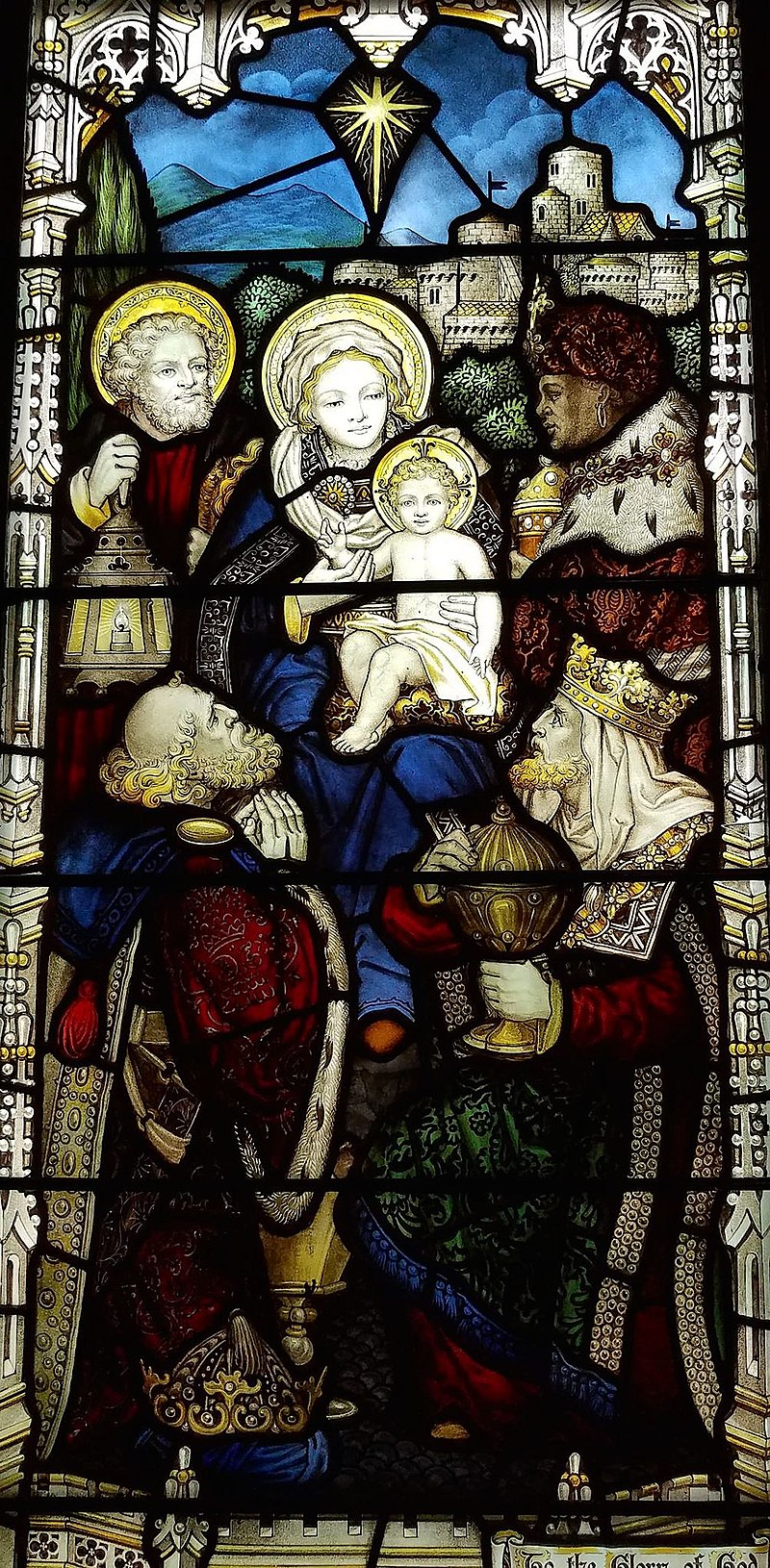
Stained glass window, ca. 1896, Church of the Good Shepherd (Rosemont, Pennsylvania)
Please Note the Mass cancellation this coming Saturday:
COLLECT
O God, who by the star this day revealed Your only-begotten Son to all nations, grant that we, who know You now by faith, may be brought one day before the vision of Your majesty. Through the same Jesus Christ, our Lord . . .
Commemoration of SAINT HYGINUS Hyginus ruled the Church as supreme pontiff during the four relatively peaceful years that followed the martyrdom of his predecessor, St. Telephorus, in the year 138.
O Eternal Shepherd, who appointed blessed Hyginus shepherd of the whole Church, let the prayers of this martyr and supreme pontiff move You to look with favor upon Your flock and to keep it under Your continual protection. Through Our Lord . . .
Come, ye Faithful, in joy and triumph, to Bethlehem, and gaze on the new-born King of Angels! Come, let us adore the Lord!
Don’t Stop Celebrating Christmas! But do leave your tree up at least for the Epiphany. Oh and we can leave our Nativity Scenes up until Candlemas on February 2nd.
As we celebrate Epiphanytide and we encourage our readers to learn how to keep the embers of the Christmas season burning for the next few weeks by reading this excellent 2019 article by Dr. Peter Kwasniewski.
OnePeterFive has an helpful article on the lost customs of the Octave of Christian Unity. Forgotten Customs of the Octave of Christian Unity. January 18 was the ancient feast of St. Peter’s Chair in Rome and the beginning of the Church Unity Octave, a time where the Church prayers that all separate sects will unite with Rome and become Catholic. The octave concludes on January 25, the feast of the conversion of St. Paul the Apostle. OnePeterFive has an helpful article on the lost customs of this 8-day period of prayer:
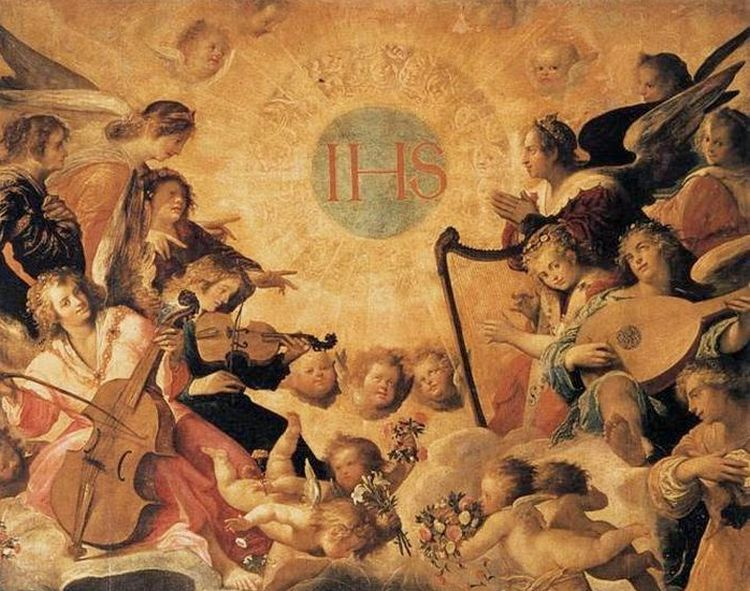
Today is the ninth day of Christmas and it is the Feast of the Most Holy Name of Jesus. It is also a special feast day for the Holy Name Society. It is also worth noting that this Confraternity, founded by Blessed John Vercelli in 1274, celebrates its 750th anniversary this year.
There is a local chapter of the Holy Name Society that has monthly meetings at St. Anthony of Padua Chapel in Mount Holly, NC. For more information on how to participate, contact HNS Secretary, Jim De Piante <jimdepiante [at] gmail [dot] com>.
The Confraternity of the Most Holy Names of God and Jesus (Holy Name Society) promotes reverence for the Sacred Names of God and Jesus Christ, obedience and loyalty to the Magisterium of the Catholic Church, and the personal sanctification and holiness of its members
Members are called to contribute to the evangelization mission of the Church and to make perpetual acts of reverence and love for our Lord and Savior. The apostolate of the society is to assist in parish ministries by performing the Corporal Works of Mercy: to feed the hungry, to clothe the naked, give drink to the thirsty, shelter to the homeless, tend the sick, visit those in prison, and bury the dead; as well as the Spiritual Works of Mercy: to convert sinners, instruct the ignorant, counsel the wayward, comfort the sorrowing, bear adversity patiently, forgive offenses, and pray for the living and the dead.
History of the Holy Name Society
Origin (13th century)
In response to the blasphemies offered to God primarily by the adherents of the Albigensian heresy gaining in popularity in Southern Europe, devotion to the Holy Name was first prescribed to the faithful by Pope Gregory X while he presided over the Second Council of Lyons in 1274, the 14th ecumenical council of the Catholic Church. Opened in the church of St. John in Rome, the Second Council of Lyons was one of the largest ecumenical councils, convoked mainly for the Crusade and to end the Great Schism and reunite the Eastern and Western Churches. This council was also the first during which the doctrine of Purgatory was defined. St. Thomas Aquinas died on the way to this council, and St. Bonaventure’s funeral sermon was given there also by the future Pope Innocent V.
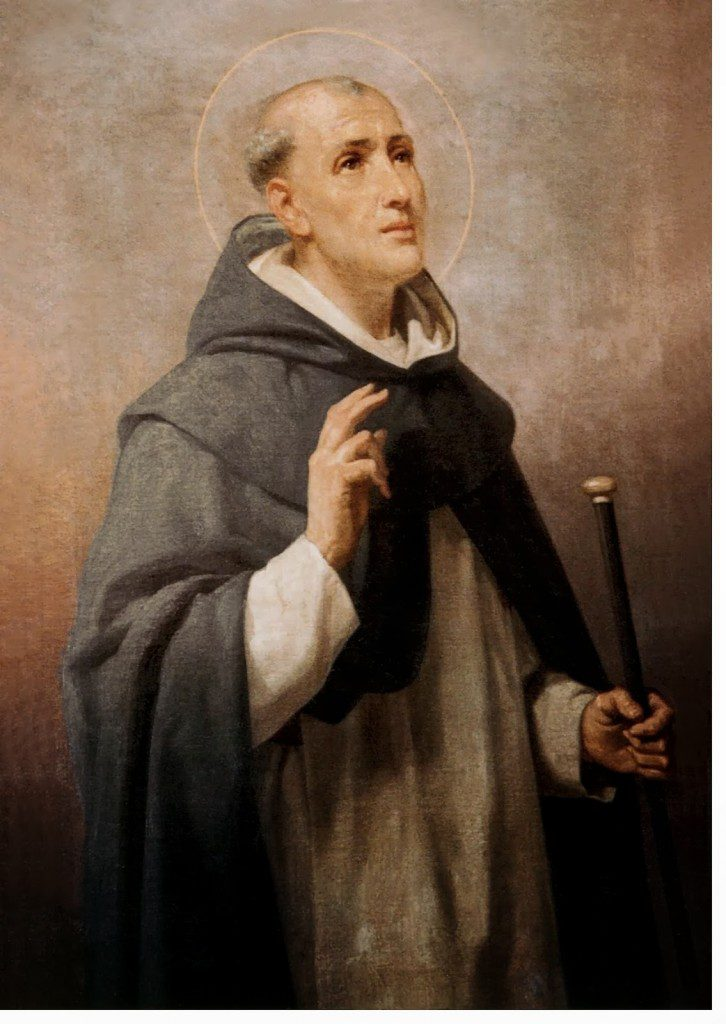
Blessed John Vercelli, Friar, Priest, Master of the Order. He is considered the patron of the Holy Name Society.
The Order of Preachers, also known as the Dominicans, were selected by Pope Gregory X to preach the devotion to the Holy Name across Europe. He did so with the following letter to Blessed John of Vercelli, then Master General of the Dominican Order:
Gregory, Bishop, Servant of the Servants of God, to our very dear son, the Master General of the Order of Preachers, salutation and apostolic benediction. Recently, during the Council held at Lyons, we deemed it a useful commendation to exhort the faithful to enter the house of God with humility and devotion, and to conduct themselves while there in a becoming manner, so as to merit the divine favor and at the same time to give edification. We have also judged it proper to persuade the faithful to demonstrate more reverence for that name above all names, the only name in which we claim salvation- the name of Jesus Christ, Who has redeemed us from the bondage of sin. Consequently, in view of obeying that apostolic precept, in the Name of Jesus let every knee be bent; we wish that at the Holy Sacrifice, every one would bow his head in token that interiorly he bends the knee of his heart. Wherefore, my very dear son, we, by our apostolic authority, exhort and enjoin upon you and the brothers of your Order to use solid reason in preaching to the people, that they may be led to comply with our desires. Thus you will win the crown of justice in the day of recompense. Given at Lyons, on the twelfth Calendes of October, third year of our Pontificate.
Following his reception of the Pope’s letter, Blessed John of Vercelli immediately instructed his whole Order to carry out the will of the Holy Father. Devotion to the Holy Name of Jesus then spread rapidly to Catholics across Europe, with many altars being erected in Dominican churches explicitly in honor of the Holy Name of Jesus. Additionally, confraternities under the title and invocation of the Holy Name were established.
Obscurity (14th century)
During the 14th century, the Holy Name Society fell into relative obscurity when compared with its beginning in the preceding. Existence of the Society is confirmed by papal bulls addressed to the Order of St. Dominic.
Wider recognition; the “Society” (15th century)
After a century of obscurity, the Holy Name Society grew in popularity, practical devotion, and recognition by popes. First, Pope Boniface IX granted indulgences for visiting the altar of the confraternity in the Dominican monastery at Schusen in the Diocese of Werden in Saxony. Second, citizens of Lisbon held the first Holy Name procession in gratitude for the Holy Name devotion, which saved them from plague. Also during this century, there were many saints who glorified the Holy Name of Jesus, and spread devotion to it. St. Bernardine of Siena gained great renown as a promoter of the devotion in Italy, writing that “the name of Jesus is the glory of preachers, because the shining splendor of that name causes his word to be proclaimed and heard.” So too, Didacus of Victoria became known as the “great preacher of the devotion”, and founded the “Society of the Holy Name of God”. Ordered to suppress profanation of the Divine Name by blasphemers, perjurers, and by men in their ordinary conversation, this was the first time the confraternity was given the title “Society”, as we now know it today. The Society of the Holy Name of God was also the first to document a rule and constitution for its government, which was later approved, endowed indulgences, commanded favor from all ecclesiastical authorities, and especially recommended to the laity by Pope Pius IV in April 1564. Another common name for the Society was the “Confraternity against Oaths”.
Gaining steam into modern times (16th century-present)
More popes, especially Innocent XI, continued to bolster the Holy Name Society, making it an object of special solicitude. In current times, there are estimated to be approximately 500,000 men of the society in the United States. They are required to receive Holy Communion in a body at least once every three months, though many receive more regularly, on the second Sunday of every month. Father McKenna’s “Pocket Manual of the Holy Name Society” contains all the corresponding indulgences and constitutional recommendations for local Society chapters.
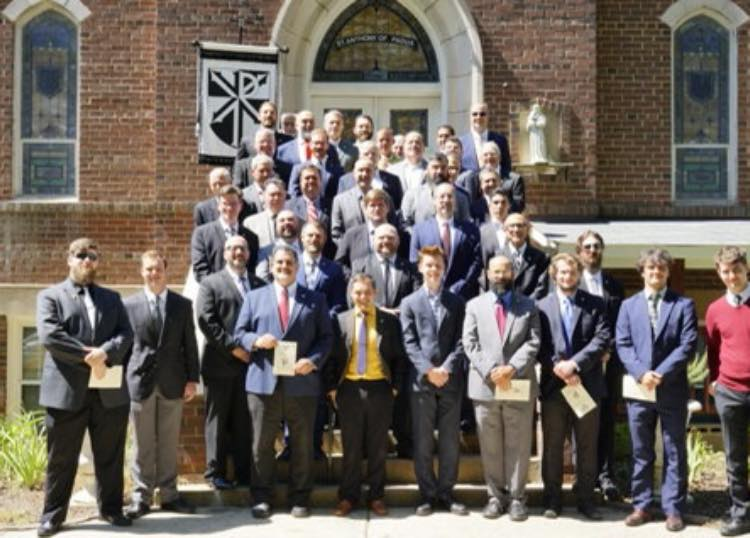
Holy Name Society Professions, St. Anthony of Padua Chapter, Charlotte USA (August 2022)
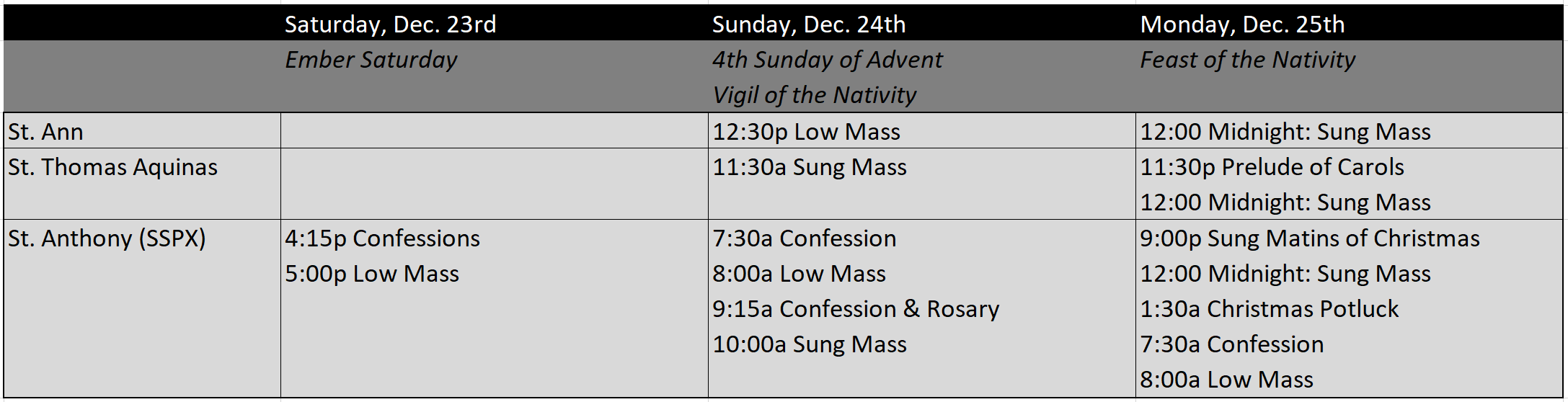
The 12:30pm Sunday Mass at St. Ann’s will be a Sung Mass as normal and not a Low Mass as had been published. The correction has been made also on the CLMC website. Please forgive the error.
St. Ann: Sunday, Dec. 24th: 12:30p Low Mass Monday, Dec. 25th: 12:00 Midnight Sung Mass
St. Thomas Aquinas: Sunday, Dec. 24th: 11:30a Sung Mass Monday, Dec. 25th: 11:30p Prelude of Carols 12:00 Midnight Sung Mass
St. Anthony of Padua (SSPX): Saturday, Dec. 23rd: 4:15p Confession 5:00p Low Mass Sunday, Dec. 24th: 7:30a Confession 8:00a Low Mass 9:15a Confession 10:00a Sung Mass Monday, Dec. 25th: 9:00p Traditional Matins of Christmas 11:00p Confession 12 Midnight Sung Mass 1:30a Christmas Potluck
What are Matins?
We are blessed to have the traditional office of Matins being sung here in the Charlotte area. Matins is the Morning Office of the Divine Liturgy of the Church. It consists of four parts:
The introduction, which consists of private prayers
The Invitatory
A hymn
Three Nocturns, each of which consists of:
Three psalms, naturally preceded and succeeded by an antiphon
Three lessons, each succeeded by a responsory
Thus, there are a total of nine psalms, nine lessons, and nine responsories.
[Aside: The so-called Christmas Cantata over at the local Protestant church consisting of nine lessons and carols is a corruption of Matins of Christmas.]
There is no better way to prepare for the birth of Our Lord than in the manner prescribed by Holy Church in her Divine Office.
Excerpt from Fisheaters: “At the darkest time of the year, we are reminded of the Light to come with the tradition of Advent Rorate Masses, whose name derives from the first words of the Introit, Isaias 45:8:
Rorate, caeli, desuper, et nubes pluant justum, aperiatur terra, et germinet Salvatorem. Drop down dew, ye heavens, from above, and let the clouds rain the just: let the earth be opened and bud forth a Saviour.
These Masses are devoted to Our Lady as the bearer of God, so the priest’s vestments are white instead of the violet typically worn in Advent. The only light allowed is candlelight — often from a great plenitude of candles — and because the Mass is offered before dawn, it begins in near darkness, becoming increasingly light-filled with the rising of the Sun — a lovely and dramatic symbolism of our being in darkness but awaiting the coming of the Son, Who’ll arrive at the midnight between Christmas Eve and Christmas Day.”
Pre-Dawn Mass Times in the Charlotte area are as follows:
St. Thomas Aquinas in Charlotte, NC:
6:00am Sung Mass
St. Ann in Charlotte, NC:
6:30am Sung Mass
St. John the Baptist in Tryon, NC:
6:00am Sung Mass
Holy Cross in Kernersville, NC
6:00am Mass
Prince of Peace in Taylors, SC:
6:30am Mass
If we become aware of any other Mass times we will update this site.
FYI, this post is only regarding the pre-dawn Rorate Masses, the regular Saturday evening Mass offered at St. Anthony of Padua (FSSPX), is scheduled as previously announced, 4:15pm Confession & 5:00pm Low Mass.







 Charlotte Latin Mass Community