FYI, regularly scheduled Latin Masses during the Thanksgiving holidays are prone to cancellation. Please check parish websites, bulletins, or social media pages to verify prior to making plans.
We are aware of the following cancelations:
St. Thomas Aquinas in Charlotte, NC: Thursday 7pm Latin Mass is cancelled
St. Ann in Charlotte, NC: Friday 7am & Saturday 8am (Respect Life) Latin Masses are cancelled
St. Elizabeth of the Hill Country in Boone, NC: Friday 9:30am Latin Mass is cancelled
Prince of Peace in Taylors, SC: Thursday, Friday 12noon & Saturday 8am Latin Masses are cancelled
Happy Thanksgiving to you and your families. Be safe in your travels.
Dear Friends of the Charlotte Latin Mass Community,
Laudetur Iesus Christus!
Happy Birthday to the Blessed Virgin Mary … as today is the Feast of her Nativity.
We have a few updates to share, but first a quick note on changes to our email format. In the past, our CLMC group would send out weekly long-form emails that were more of a newsletter format. Going forward, our CLMC emails will be more focused on calendar announcements and changes. Over time, this will result in fewer and shorter emails.
Our website [charlottelatinmass.org] has been updated and enhanced to include more comprehensive content and it will be updated more regularly.
Updates & Announcements:
1. Upcoming Major Feasts: – Thurs, Sept 14th: Exaltation of the Holy Cross (7:00pm High Mass at St. Thomas Aquinas) – Fri, Sept 15th: Seven Sorrows of the Blessed Virgin Mary (7:00am Low Mass at St. Ann)
Also note the Holy Cross Ember Days fall in the third week of September: – Wednesday, September 20th: Ember Wednesday (6:00pm Low Mass at St. Ann, Charlotte) – Friday, September 22nd: Ember Friday (7:00am Low Mass at St. Ann, Charlotte) – Saturday, September 23rd: Ember Saturday (5:00pm Low Mass at St. Anthony, SSPX)
3. St. Thomas Aquinas in Charlotte; the Carolina Pro-Life Action Network (C-PLAN) and the Kolbe Center for the Study of Creation are presenting a 2-day seminar titled: Evolution and the Culture of Death. The dates are September 29th & 30th in Aquinas Hall. See attached flyer for more details.
4. St. Anthony’s (SSPX) in Mount Holly will be hosting their annual Rosary Day celebration on Saturday, October 7th (the Feast of the Most Holy Rosary):
3:15 pm Confession 4:00 pm Sung Mass of the Most Holy Rosary 5:30 pm Rosary procession 6:00 pm Festivities (bratwursts, hot dogs, beer, soda, snacks)
If you are aware of any other announcements that we missed please send us a quick note.
The word schism means separation or to open up. God’s first act was to create a schism when God said, “Let there be light”; and there was light. And God saw that the light was good; and God *separated* the light from the darkness.
Those who adhere to the unchangeable teachings of the Church are often falsely accused of being “schismatic” by men who have assumed positions of power and who abuse this power to change the teachings of the Church.
Since all authority comes from God, the Church is infinitely powerful to defend her traditional teachings. Conversely, the Church has no authority or power to change them.
Father Byers writes:
“Schism isn’t always bad and evil. Jesus came not to bring peace, but the sword of Truth, not unity with Satan, but rather unity with God to the exclusion of Satan.
Those repentant of sin, confessing their sin as they went down for baptism, rejoiced to see the heavens schism-ing open. The unrepentant, the brood of vipers, hated this.
Those … comfortable with the darkness, shake their fists at God all the more because of the schism-ing light which also casts a light on their sin.
– Schism is always bad and evil, they say. – Obey us, puppets of ours that you are, they say. – Don’t incriminate us of our sins by way of God’s truth, they say. – We’re afraid of the light, they say. – Schism is always bad and evil, they say.
But we must remain with God who separates the light from the darkness, God’s first act in His creation.”
For those who were not aware, back in 2010, the traditional blog, Rorate Caeli organized a Purgatorial Society. This is a registry of traditional priests (112 priests at present) who have signed up to offer weekly or monthly traditional requiem Masses for the enrolled souls of the Purgatorial Society.
There is no cost to enroll souls in the Purgatorial Society.
How to enroll souls: To enroll, send email to: athanasiuscatholic@yahoo.com and submit as follows: “Name, State, Country.” If you want to enroll entire families, simply write in the email: “The Jones family, North Carolina, USA”. Individual names are preferred. Be greedy — send in as many as you wish and forward this posting to friends as well.
Please consider forwarding this Society to your family and friends, announcing from the pulpit during Holy Mass or listing in your church bulletin. We need to spread the word and relieve more suffering souls.
Address: 108 Horseshoe Bend Beach Road, Mount Holly, NC 28120
This vigil day is a penitential day of preparation for the Feast of the Assumption of the Blessed Virgin Mary tomorrow. As part of this day of preparation, it is also customary to fast.
While no longer binding under pain of sin, today’s fast traditionally would apply to those aged 21 to 59 (inclusive). Fasting as explained by the U.S. bishops conference means partaking of only one full meal. Some food (not equaling another full meal) is permitted at breakfast and around midday or in the evening—depending on when a person chooses to eat the main or full meal.
Attached below is an in depth article on the Vigil of Assumption by Gregory DiPippo at New Liturgical Movement.
Dear friends of the Charlotte Latin Mass Community,
Laudetur Iesus Christus! Today, August 11 is the Feast of Ss. Tiburtius (Martyr) & Susanna (Virgin and Martyr) and St. Philomena (Virgin and Martyr).
Coming up next Tuesday, August 15 is the Feast of the Assumption of the Blessed Virgin Mary which is a Holy Day of Obligation. Below are the Latin Mass Times in the greater Charlotte area:
Feast of the Assumption of the Blessed Virgin Mary Tuesday August 15, 2023 (August 15th is a Holy Day of Obligation)
St. Ann, Charlotte, NC (4 miles from downtown Charlotte)
Dear Friends of the Charlotte Latin Mass Community,
Laudetur Iesus Christus and Happy Feast of St. Ignatius!
The Charlotte Latin Mass Community, Inc. (CLMC) is registered with the State of North Carolina as a Non-Profit Corporation (SOSID: #132258).
This morning, the officers of the CLMC informed Mike FitzGerald that we have decided to end Mike’s relationship with the CLMC. As such Mike will no longer be representing the CLMC in future emails, meetings, or any other way.
Mike has done a lot of work gathering and disseminating information for subscribers to the CLMC email distribution list. Mike may choose to form a new organization and continue sending out email updates in the future. We wish him well and if we hear of any new worthy organizations, we will share information on how people can subscribe to those.
Laudetur Iesus Christus! Sunday is the ninth Sunday after Pentecost, in which the Church also subtly marks the fall of Jerusalem in A.D. 70. We share a few reflections for Sunday’s Latin Mass and provide more commentary towards the end of this update:
Wednesday August 2, 6pm – St. Ann (feast of St. Alphonsus Liguori, Bishop and Doctor)
Thursday August 3, 7pm – St. Thomas Aquinas (Feria, e.g. no feast day)
Friday August 4, 7am – St. Ann (feast of St. Dominic, Confessor)
Saturday August 5, 10am – St. Thomas Aquinas (Our Lady of the Snows & First Saturday) – a blessing of religious objects in the traditional rite will occur after Mass
1st Sunday Latin Mass in Salisbury, August 6, 4pm: Looking ahead, there will be a Latin Mass at Sacred Heart parish in Salisbury on Sunday August 6th at 4pm. Mass will be offered by Fr. Joseph Wasswa, with Confession starting at 2:45pm. Seminarians from St. Joseph College Seminary will graciously provide sacred music. A potluck will be held in Brincefield Hall afterwards. Please bring a favorite dish, hors d’oeuvres or dessert to share. For more information contact the Salisbury Latin Mass Community: www.salisburylmc.org
1st Sunday Potluck at St. Thomas Aquinas, August 6: On Sunday August 6 there will be a potluck after the 11:30am Latin Mass at St. Thomas Aquinas.
Feast of the Assumption Latin Masses – Tuesday August 15 (as announced)
Each August 2nd, there is a plenary indulgence related to St. Francis of Assisi called the Portiuncula Indulgence which originally was only available to those who visited a chapel he rebuilt in Italy, but the indulgence now extends to the universal Church. The indulgence can be made any time after Vespers the evening of August 1st and until sundown on August 2nd. A plenary indulgence is available under the usual conditions:
Receive sacramental confession (8 days before or after)
Receive the Holy Eucharist at Holy Mass on August 2nd
Enter a parish church and, with a contrite heart, pray the Our Father, Apostles Creed, and a pray of his/her own choosing for the intentions of the Pope
Learn the Divine Office – Thursday August 3, 5-5:45pm (St. Thomas Aquinas parish) (CORRECTED TIME)
St. Thomas Aquinas parish announced the following event: It’s been said that the Divine Office is an extension of the Mass throughout the day, meant to sanctify the hours of the day by way of the Psalms. On Thursday, August 3 from 5-5:45 in Room D in the parish building, before the evening Latin Mass, Deacon Kevin Martinez and seminarian Emanuel Martinez will give a brief introduction to any families interested in praying either the Divine Office (according to the traditional form) or the Little Office of Baltimore. The event is open to all and no sign up is necessary.
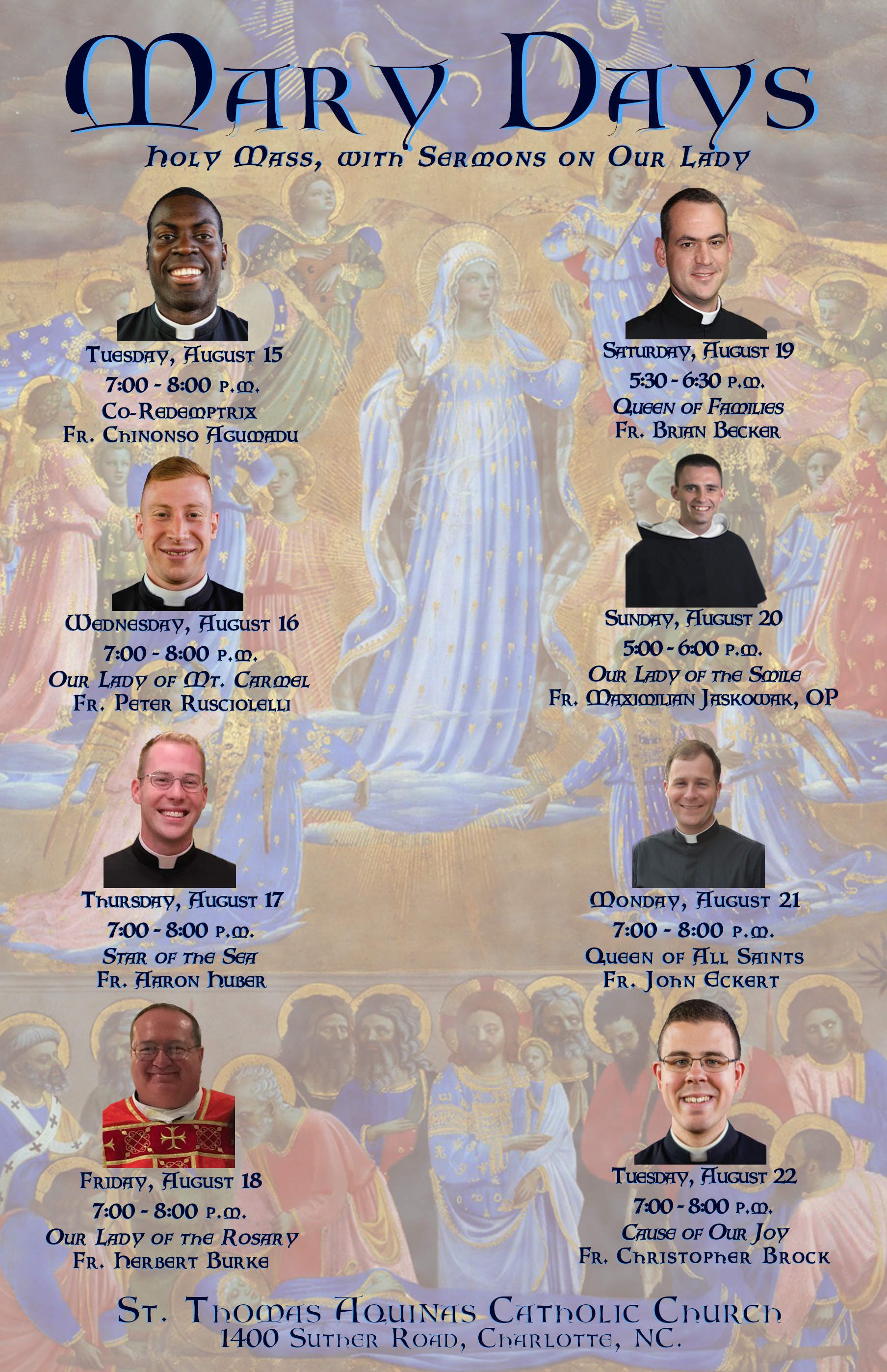
Mary Days at St. Thomas Aquinas – Thursday August 17, 7pm
St. Thomas Aquinas is hosting its annual Mary Days during August which features Masses, and a sermon on the Blessed Mother by a visiting priest. On Thursday August 17, 7pm, during the regularly scheduled Latin Mass, Fr. Aaron Huber will provide a talk on the Marian title, Star of the Sea. See details in the attached image.
St. Thomas Aquinas Parish Needs Eucharistic Adorers
This weekend at St. Thomas Aquinas, Father is planning to preach about the importance of Eucharistic Adoration and encouraging families to commit to an hour of prayer in their new Eucharistic Adoration chapel. The parish needs only 52 more people to commit to an hour before they launch their perpetual Adoration chapel. For those St. Thomas Aquinas Latin Mass attendees (who are able to commit), this would be a great opportunity to pray for the preservation of the Latin Mass. To see what hours are needed visit: https://staclt.weadorehim.com/ or visit: https://www.stacharlotte.com/perpetual-adoration
Holy Face Devotions
St. James, Concord– Mondays 10-10:30am in the cry room in the church
St Mark – Mondays 5pm in the church
St. Thomas Aquinas – Tuesdays 6am in the church
St. Ann – Tuesdays 7:30am in the main church after the Novus Ordo Mass (uses the booklet/chaplet which takes 15-20 minutes)
St Michael the Archangel, Gastonia – Tuesdays, 9am, in the church
Holy Spirit, Denver – Tuesdays 10-11am after the Novus Ordo Mass
Don’t see your parish? Why not organize one?
Conversion of the Lost Sheep Novena and Mass Intentions
The St. Alphonsus Liguori Shrine in Baltimore, the Latin Mass shrine staffed by priests of the Priestly Fraternity of St. Peter, has started its annual novena to St. Alphonsus ahead of his feast day on August 2nd and the Shrine invites all to join them. They are also offering prayers and Mass intentions for the conversion of those who have fallen away from the faith. To submit intentions and join them in praying the last few days of the novena, which started last Monday, please visit this website: https://stalphonsusbalt.org/return#saint-alphonsus-prayer (please see attached novena prayer for the novena or download it at the link).
St. Peter and the First Years of Christianity: As the Church, in the traditional rite, commemorates the feast of St. Peter in Chains on August 1, the Priestly Fraternity of St. Peter (FSSP) is promoting a reprint of Abbe Constant Fouard’s 19th century book, St. Peter and the First Years of Christianity, which examines the life of St. Peter, and the time period he began to lead the Church. To learn more visit: https://fraternitypublications.com/product/st-peter-and-the-first-years-of-christianity/
Funeral Sermon for Charles Anthony Ripperger: In your charity please consider praying for the repose of the soul of Charles Anthony Ripperger, father of Fr. Chad Ripperger, the traditional exorcist who visited St. Thomas Aquinas earlier this year. Father Ripperger offered a beautiful sermon at his father’s Requiem Mass. To watch visit: https://www.youtube.com/watch?v=w6t2X45w-D0
Cardinal Burke’s Sermon On Our Lady of She-Shan: Last Tuesday, His Eminence Cardinal Raymond Burke offered a Pontifical Latin Mass at St. John the Evangelist’s Basilica in Stamford, Connecticut in honor of Our Lady of She-Shan, the Marian title of the Blessed Mother in China. The Mass was also to offer prayers for the underground Church in China, which is supported by the Cardinal Kung Foundation, named after Cardinal Ignatius Kung, who spent 30 years in a Chinese communist prison before being exiled to the US in 1988 where he died in Connecticut in 2000 (he also offered the Latin Mass in his later years). To view the sermon click on this link (the sermon occurs at the 1 hour mark): https://boxcast.tv/channel/ppcsuohvx2la96vu23yv?b=kjodhajii5otatsvm1nx To support the underground Church in China please visit: http://www.cardinalkungfoundation.org/
Vatican Grants Plenary Indulgence For St. Thomas Aquinas Jubilee Celebrations: Last week marked the start of the 700th year of the canonization of St. Thomas Aquinas, and the Church has granted a plenary indulgence until 2025 which will be the 800th anniversary of his birth. The indulgence can be obtained by visiting any church, chapel, connected with the Dominican Order. Practically speaking, this indulgence can be obtained in cities where the Dominicans have a presence of some kind (if anyone is aware of such locations in our diocese, let us know). To learn more visit: https://www.ncregister.com/cna/vatican-grants-plenary-indulgence-for-st-thomas-aquinas-jubilee-celebrations
A Superb Article on St Mary Magdalene: A week ago Saturday was the feast of St. Mary Magdalene (with yesterday, the eighth day after her feast, commemorating the feast of her sister, St. Martha). In reflecting upon the great penitent, we share a recommendation by Greg DiPippo about an excellent article on St. Mary Magdalene. To learn more visit: https://www.newliturgicalmovement.org/2023/07/a-superb-article-on-st-mary-magdalene.html
The Fall of Jerusalem – Ninth Sunday After Pentecost
The ninth Sunday after Pentecost, through the Gospel reading, marks the fall of Jerusalem by the Romans in A.D. 70, occuring around this time of the year. This fateful event, prophesized by Our Lord (Luke 19:41-48) and commemorated this Sunday, was one of the more horrific sieges in history and it occurred around this time of the year. Dom Prosper Gueranger noted that the Temple of Jerusalem flowed with blood, most of its inhabitants killed, not just by Roman soldiers from without, but by the lawless, unspeakable violence of Jewish Zealots (upon their own people) from within the city walls. Further north, the sea of Galilee turned red as bodies piled up along the shoreline after that Jewish revolt was crushed by the Romans. Jewish historian Josephus had reported that years prior to the siege, residents of Jerusalem would see signs in the sky including a flaming meteorite/sword and chariots foretelling the pending doom (Luke 21:11). The Catholics of that day, seeing the signs, were spared the terror as they remembered Christ’s prophecy (Luke 21:21, Matthew 11:21-24), and escaped to safe harbor. We share just one excerpt from Gueranger but one should read his entire description at the link below.
The lamentation over Jerusalem’s woes, the subject of today’s Gospel, has given its name to this ninth Sunday after Pentecost, at least among the Latins. We have already observed that it is easy to find, even in the liturgy as it now stands, traces of how the early Church was all attention to the approaching fulfilment of the prophecies against Jerusalem—that ungrateful city upon which our Jesus heaped His earliest favours. The last limit put by mercy upon justice has, at length, been passed. Our Lord, speaking of the ruin of Sion and its temple, had foretold that the generation that was listening to His words should not pass until what He had announced should be fulfilled. The almost forty years accorded to Juda, that he might avert the divine wrath, have had no other effect than to harden the people of deicides in their determination not to accept Christ as the Messiah. As a torrent, which, having been long pent back, rushes along all the fiercer when the embankment breaks, vengeance at length burst on the ancient Israel; it was in the year 70 that was executed the sentence he himself had passed when, delivering up his King and God to the Gentiles, he had cried out: ‘His blood be upon us and upon our children!’
Looking ahead a few days to August 1st, the Church has two commemorations set for this day. As noted earlier in this update, the first commemoration of August 1st is that of St. Peter in Chains. However, the second commemoration of August 1st is an often overlooked commemoration, that of the Holy Maccabees – the only Old Testament saints listed in the universal 1962 calendar (parenthetically, the Carmelites do commemorate another Old Testament saint, the Prophet Elijah, on July 20). These seven holy Maccabee brothers were martyred defending the rights of God and for His public worship in a pagan culture. Their relics are actually buried in the same church that houses the chains of St. Peter, drawing a connection between the two commemorations which share the same day. For more on the liturgical aspects of this feast day visit: http://www.newliturgicalmovement.org/2018/08/the-feast-of-holy-maccabees.html#.XyOweX57nwc
To close this update, we share the words of Dom Prosper Gueranger who writes about the Maccabean martyrs in his entry for August 1 in his book, The Liturgical Year:
The sacred cause of which they were the champions, their strength of soul under the tortures, their sublime answers to the executioners, were so evidently the type reproduced by the later Martyrs, that the Fathers of the first centuries with one accord claimed for the Christian Church these heroes of the synagogue, who could have gained such courage from no other source than their faith in the Christ to come. For this reason they alone of all the holy persons of the ancient covenant have found a place on the Christian cycle; all the Martyrologies and Calendars of East and West attest the universality of their cultus, while its antiquity is such as to rival that of St. Peter’s chains in that same basilica of Eudoxia where their precious relics lie.
Laudetur Iesus Christus! Today Wednesday July 26 is the feast of St. Anne, mother of Our Lady, and also patronal feast day for St. Ann parishioners. St. Ann will offer a 6pm Latin Mass this evening.
According to tradition, the relics of St. Anne were taken by Ss. Lazarus, Mary Magdalene and Martha when they were exiled from the Holy Land. By Divine Providence, their small raft landed in Marseille, France, where St. Lazarus became its first bishop.
Interestingly (and perhaps providentially), St. Anne’s feast day, July 26, falls between the feasts of Ss. Mary Magdalene (July 22) and Martha (this Saturday July 29), perhaps as a connection to those two saints (and their brother) who the transported her relics to France. The feast of St. Anne’s husband, St. Joachim, is celebrated on the day after the Our Lady’s Assumption on August 16 (the 2nd day within the ancient Octave of the Assumption).
In Jerusalem, not far from the Via Dolorosa (Way of the Cross) and St. Stephen’s Gate (where St. Stephen was martyred) is the Church of St. Anne, which is the place where St. Anne and her husband St. Joachim lived, and where, in the church’s crypt, the Blessed Mother was reported to be born (there are some other traditions placing it elsewhere but she at least lived there). The current Church was built by Crusaders in the 12th Century and was spared destruction by the Muslims who retook Jerusalem shortly thereafter. The acoustics in the church are beyond description and ideal for Gregorian Chant. The Church is also a stone’s throw away from the Pool of Bethsaida (Probotica) where Christ healed the paralytic man (John Chapter 5:2-9). Incidentally, tradition also holds that it was St. Raphael the Archangel who was the angel that would stir the water in the pool at different times of the year. How interesting that this small little neighborhood witnessed so many saints during Our Lord’s time on Earth (or shortly after). We link to a brief description.
Conversion of the Lost Sheep Novena and Mass Intentions
Lastly, the St. Alphonsus Liguori Shrine in Baltimore, the Latin Mass shrine staffed by priests of the Priestly Fraternity of St. Peter, has started their annual novena to St. Alphonsus ahead of his feast day on August 2nd and the Shrine invites all to join them. They are also offering prayers and Mass intentions for the conversion of those who have fallen away from the faith. To submit intentions and join them in praying the novena please visit this website: https://stalphonsusbalt.org/return#saint-alphonsus-prayer (please see attached prayer for the novena or download it at the link).

 Charlotte Latin Mass Community