
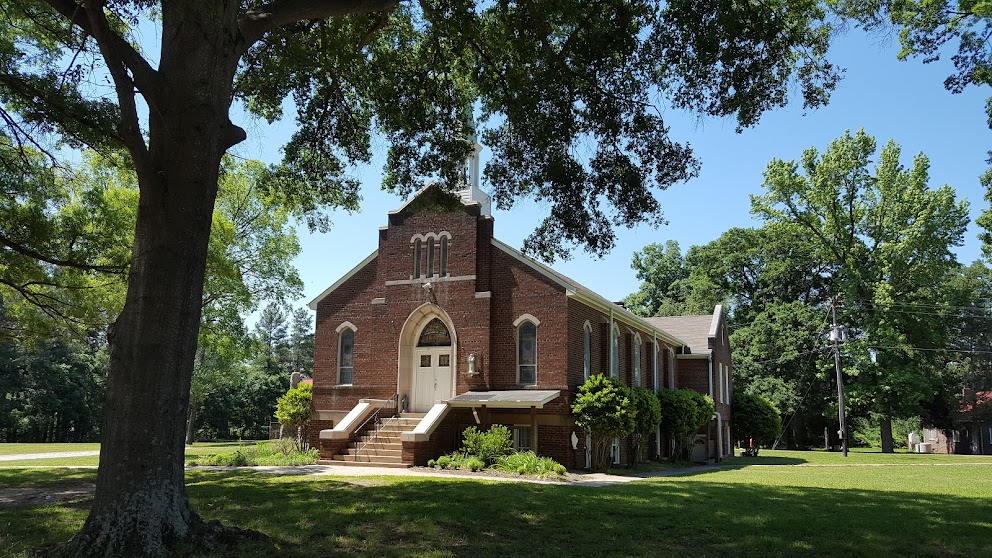
Photo Caption: St. Anthony of Padua Chapel 108 Horseshoe Bend Beach Road, Mount Holly, NC 28120
Can the faithful fulfill their Sunday Mass obligation at a SSPX chapel?
In short, and without any doubt, yes.
The Society of St. Pius X (SSPX), or in Latin, Fraternitas Sacerdotalis Sancti Pii X (FSSPX), is a global fraternity of more than 700 Catholic priests founded in 1970 by the late Archbishop Marcel Lefebvre. There is a SSPX chapel located in Mount Holly, NC (just outside Charlotte) named, St. Anthony of Padua that offers the Traditional Latin Mass every Saturday (5:00 pm Low Mass) and Sunday (8:00 am Low Mass and 10:00 am Sung Mass).
The Pontifical Commission Ecclesia Dei (PCED) in the Vatican, on seven separate occasions, published letters confirming that the faithful are allowed to fulfill their Sunday Mass obligation at chapels of the SSPX. The strongest and clearest statement from the PCED came in a May 23, 2008 letter to Brian Mershon who at times attends Mass at the SSPX chapel here in Charlotte: “Catholics who frequent the chapels of the Society of St. Pius X do not incur any sin or canonical delict by doing so. … This Pontifical Commission does its best to transmit responses which are in full accord with the magisterium. … One should accept them with docility and can act upon them with moral certainty.”
According to Canon Law (Canon 1248 §1), “A person who assists at a Mass celebrated anywhere in a Catholic rite [emphasis added] either on the feast day itself or in the evening of the preceding day satisfies the obligation of participating in the Mass.” Thus, attending the Saturday or either of the Sunday Masses at St. Anthony of Padua indisputably fulfills one’s Sunday Mass obligation.
I know I can, but should I attend Mass at a SSPX chapel?
The CLMC, as an association, neither encourages nor discourages Mass attendance at SSPX chapels. The SSPX claims a “state of necessity” in their ministry. Families should likewise discern for themselves if a “state of necessity” exists for their situation. Are you spiritually nourished at your Diocesan Parish? Do find yourself praying at Mass with one eye open, with your prayer disturbed by novelties on the altar? Is the catechesis program at your diocesan parish teaching your children sound Catholic doctrine? Let these questions inform your discernment. There are good people within our community who have discerned these questions and come to different answers.
Further background
The SSPX went through a long period of persecution, however in the past 20 years in particular, the Church has been slowly rolling back and rethinking their restrictions. The Church now partially recognizes the Society. In 2016, Pope Francis issued the Apostolic Letter, Misericordia et Misera, granting the SSPX universal faculties to hear Confessions. In 2017, Pope Francis granted permission for the SSPX to witness marriages in a letter from the Congregation for the Doctrine of the Faith. The Pope stated reason for granting these faculties was, “to facilitate the process towards full institutional regularization.”
Beyond these specific granted faculties, the SSPX claims that their sacraments are valid and licit under Canon 144, through which the Church generously supplies jurisdiction under a state of necessity stemming from existence of the grave crisis in the Church. Canon Law recognizes that the preservation of the Faith and the salvation of souls is the highest law of the Church. For more in depth reading, we recommend the book, SSPX: The Defense by Kennedy Hall.
Since the 1980s, priests of the SSPX have traveled to the Charlotte area to hold Masses and administer sacraments at the request of faithful Catholics who, in desperation, have likewise expressed a state of necessity. In 2000, a small chapel in Mount Holly, NC, was acquired through donations from the faithful. Throughout all of these years, even during the periods of persecution, portraits of the bishop of the Diocese of Charlotte and the Holy Father have been displayed in this chapel. In addition, their names are included in the prayers of the Canon of the Mass, setting the SSPX apart from other groups not in communion with the Catholic Church.
The most comprehensive and well researched opinions we could find on the topic are below:
- Father John Zuhlsdorf (“Father Z”) on the Truth of the SSPX
- Note that Father Zuhlsdorf worked for years in Rome at the Congregation for the Doctrine of the Faith and Pontifical Commission Ecclesia Dei, working daily on this topic with then Cardinal Joseph Ratzinger. He is highly respected on these matters.
- Note that Father Zuhlsdorf worked for years in Rome at the Congregation for the Doctrine of the Faith and Pontifical Commission Ecclesia Dei, working daily on this topic with then Cardinal Joseph Ratzinger. He is highly respected on these matters.
- Bishop Athanasius Schneider Defends the SSPX
- Note that Bishop Athanasius Schneider was appointed by the Vatican to conduct an official visitation to two SSPX Seminaries and to continue doctrinal discussions on behalf of the Vatican.
- Note that Bishop Athanasius Schneider was appointed by the Vatican to conduct an official visitation to two SSPX Seminaries and to continue doctrinal discussions on behalf of the Vatican.
- Bishop Vitus Huonder (Three part video series on the SSPX: Each video is only about 15-mins)
- Note that the late Bishop Huonder was appointed by the Congregation for the Doctrine of the Faith to begin doctrinal discussions with the SSPX as the Vatican’s official representative. His expertise on these matters is unmatched.
- The Great Wound Part One
- The Great Wound Part Two
- The Great Wound Part Three: Overcoming the Crisis
- Crisis Magazine: “The Status of the SSPX” Eric Sammons Interviews James Vogel
- Note: Crisis Magazine is a well-respected neoconservative Catholic opinion journal founded in 1982. This interview is a respectful, thorough, open, and objective discussion between the editor of Crisis Magazine, Eric Sammons (an admitted SSPX skeptic), and the Director of Communications for the US District of the Society of St. Pius X. They very calmly unpack and discuss various points of controversy regarding the status of the SSPX.
Are newcomers welcome at St. Anthony’s?
This question about newcomers being welcome was asked of Jim De Piante, a longtime attendee at St. Anthony’s, during an interview with Matt Gaspers, he replied, “Every person at St. Anthony’s has a diocesan parish and a pastor—and we all have a bishop. We went to our pastors and our bishop over the years, and we asked for bread, and instead they offered us stones. So we left the comfort and security of our parish churches—in some cases, extraordinarily and exquisitely beautiful temples that our fathers and grandfathers caused to be built. We suffered ostracization, derision, and ridicule. When we consider newcomers who will be coming to St. Anthony’s, we do not consider them to be ‘outsiders’—they are ‘us.’ They’re part of the same pool of refugees to which every single one of us belongs.”
“On the one hand, there are certainly no organized initiatives to recruit people from diocesan parish churches; on the other hand, we are not turning anybody away. We will welcome you. So I expect we will see an uptick. But you have to want to go there. It’s not easy to go to St. Anthony’s. You have to be prepared to make sacrifices. It’s certainly not as luxurious as your parish church, I assure you of that. And it’s going to be crowded. Some of us might have to sit downstairs and watch on a video screen. And I will tell you, especially for the women, you are going to lose friends, you’re going to be ostracized, you’re going to be pilloried; and this is in large measure owing to the misinformation and disinformation coming from the keyboard canonists. You are going to be falsely branded as a heretic or a schismatic. People who you thought were your friends will deride you.
“But here is what you get for your troubles: the fullness of Catholic tradition, guaranteed quite literally from cradle to grave. There will be Mass every Sunday (Low Mass and Sung Mass) and on most Holy Days (we’re working on that). You will get traditional Baptism, traditional Confession, traditional First Holy Communion, traditional sermons, traditional catechism for all ages, traditional Easter Triduum, traditional Confirmation, traditional weddings, traditional Holy Orders, traditional Extreme Unction, and finally a traditional funeral Mass and graveside service. That is what we have to offer.”
 Charlotte Latin Mass Community